
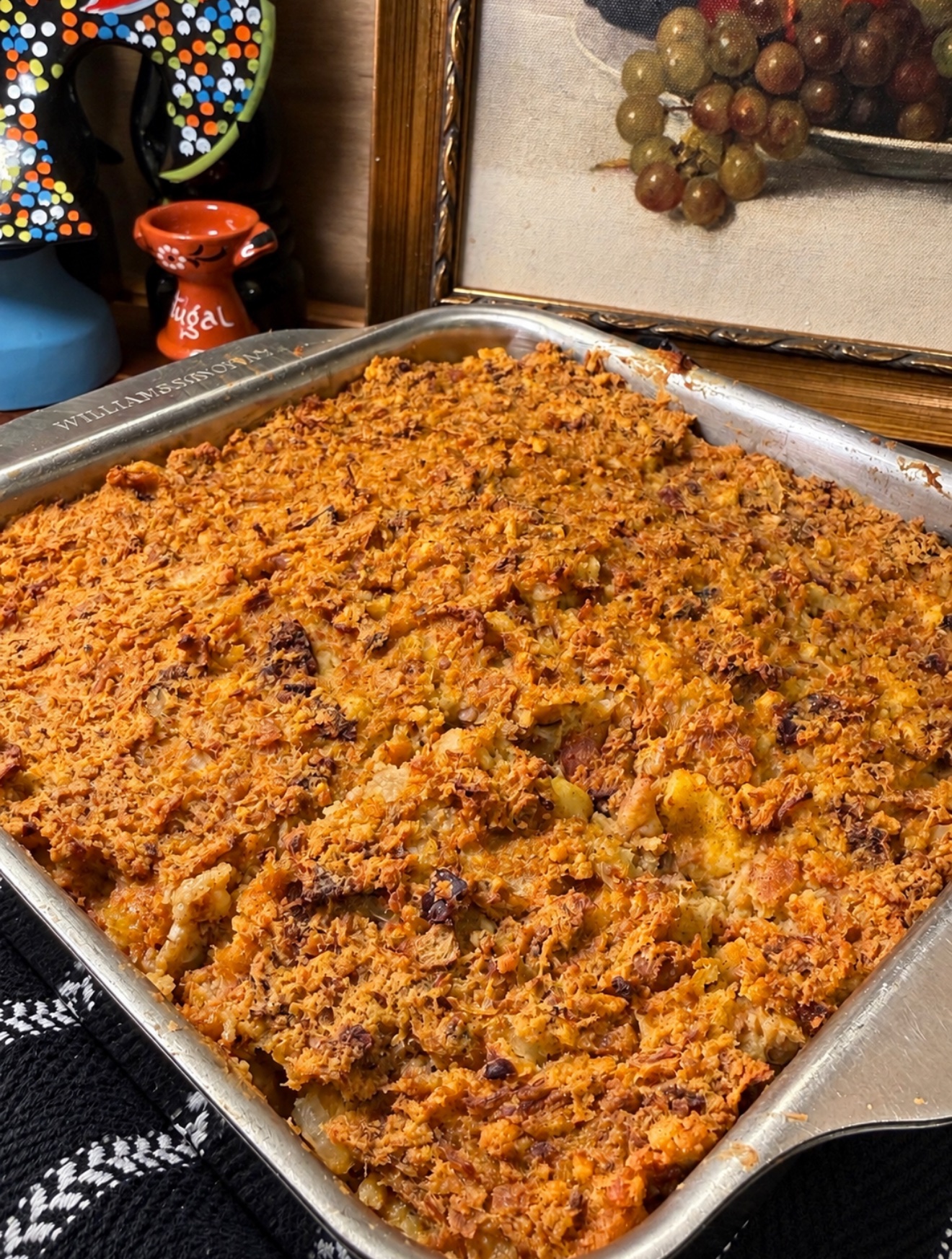
This Portuguese Stuffing is hands down the only stuffing recipe you need. Made with pão de milho, Portuguese chouriço, pimenta moída, warm spices and a few simple ingredients, it’s incredibly moist inside with the most delicious golden, slightly crispy top. Whether you’re Portuguese or not, save this one. It is THAT good. ❤️
This recipe is extra special to me because it’s my mother-in-law’s recipe, and after making it myself, I completely understand why everyone loves it so much.
Stuffing as we know it here in Canada and the United States isn’t necessarily a traditional Portuguese holiday dish. But THIS stuffing takes the idea of the stuffing we all know and love and fills it with flavours that feel completely Portuguese. 🇵🇹
We’re talking pão de milho, chouriço, pimenta moída, paprika, garlic, cinnamon and Portuguese safflower all coming together in one dish.
And let me tell you… this may be the best stuffing I have ever had.
It’s savoury, rich and full of flavour, but what I love most is the texture. The inside stays beautifully moist while the top gets golden and slightly crispy.
Whether you’re serving Thanksgiving dinner, Christmas dinner, or just making a big Sunday family meal, this is the only stuffing recipe you need.
Jump to:
- ❤️ Why You’ll Love This Portuguese Stuffing
- What Makes This Stuffing Portuguese? 🇵🇹
- 🍞 What Bread Should I Use for Portuguese Stuffing?
- 🌭 Why I Pressure Cook the Chouriço First
- 🌾 Portuguese Safflower vs. Saffron
- Portuguese Stuffing Ingredients
- How to Make Portuguese Stuffing
- Make-Ahead Portuguese Stuffing
- How to Store Portuguese Stuffing
- Portuguese Stuffing FAQs
- What to Serve with Portuguese Stuffing 🇵🇹
- From My Cozinha to Yours ❤️
- 🇵🇹 Portuguese Stuffing
❤️ Why You’ll Love This Portuguese Stuffing
This recipe is actually very easy to make, but it tastes like something that took all day.
The bread soaks up that beautiful broth seasoned with onion, garlic, Portuguese pepper sauce and spices, while the finely ground chouriço adds so much richness and unmistakably Portuguese flavour.
It’s also:
- Perfect for Thanksgiving or Christmas
- Easy to make ahead
- Moist inside with a crispy top
- Made with simple Portuguese pantry staples
- Easy to customize with your favourite Portuguese bread
- Absolutely delicious whether you grew up eating Portuguese food or not
And the best part? You can make the entire thing the day before.
What Makes This Stuffing Portuguese? 🇵🇹
Traditional stuffing isn’t necessarily something you’ll find on every Portuguese table in Portugal, but the ingredients and flavours in this recipe are very Portuguese.
Instead of a typical white sandwich bread stuffing, we’re using pão de milho, Portuguese corn bread, along with Portuguese chouriço.
Then we build our flavour with onion, garlic, pimenta moída, paprika, cinnamon, white and black pepper, chicken broth and optional Portuguese safflower.
It’s basically everything I love about Portuguese cooking turned into stuffing. 😂❤️
And because this came from my mother-in-law’s cozinha, it also represents something I talk about all the time: our family recipes don’t have to come from a cookbook to be worth preserving.
These are the recipes we learn by watching our mothers, avós and sogras cook. And those are usually the best ones.
🍞 What Bread Should I Use for Portuguese Stuffing?
For this batch, I used:
400 g pão de milho + 400 g pão d’água (wheat bread)
I LOVE this combination.
The pão de milho gives the stuffing that rustic corn flavour and texture, while the pão d’água is a wheat bread that absorbs all of that seasoned broth beautifully.
You can absolutely use 800 g of pão de milho instead if you prefer.
My mother-in-law’s recipe allows for either:
All corn bread OR half corn bread and half wheat bread.
So play around with it and see which version your family loves.
For me, the half-and-half combination was perfect.
🌭 Why I Pressure Cook the Chouriço First
One little step from my mother-in-law’s method that I kept is cooking the chouriço before adding it to the stuffing.
I place one whole Portuguese chouriço in my electric pressure cooker with water and pressure cook it on HIGH for 1 hour.
Once it’s cooked, I remove it and let it cool enough to handle.
Then I cut it into pieces and add it to my food processor, pulsing until it’s very finely ground.
This distributes little pieces of chouriço throughout the entire stuffing rather than leaving you with large chunks in only a few bites.
Do not skip the chouriço. It adds so much flavour to this stuffing.
🌾 Portuguese Safflower vs. Saffron
For this recipe, when I say saffron, I’m referring to the Portuguese safflower often used in Portuguese cooking, sometimes labelled açaflor, rather than expensive true saffron threads.
It adds a little colour and another layer of flavour, but it is completely optional.
For this recipe, I recommend ¼ to ½ teaspoon.
You don’t need much.
Portuguese Stuffing Ingredients
For the stuffing
1 whole Portuguese chouriço
800 g bread, either 400 g pão de milho + 400 g pão d’água, or 800 g pão de milho
Cold water, for soaking
4 large egg yolks, whisked
For the seasoning mixture
1 onion, very finely chopped
3–4 cloves garlic, very finely chopped
1 tablespoon Portuguese pepper sauce (pimenta moída)
½ tablespoon sweet paprika
¼–½ teaspoon Portuguese safflower (optional)
¼ teaspoon white pepper
¼ teaspoon black pepper
½ teaspoon salt, or to taste
1 teaspoon ground cinnamon
1 cup chicken broth
1 tablespoon butter
Optional garnish
Finely chopped fresh parsley
A little reserved ground chouriço
How to Make Portuguese Stuffing
- Cook the chouriço
Place the whole chouriço in your pressure cooker with water.
Pressure cook on HIGH for 1 hour.
Carefully remove the chouriço and allow it to cool enough to handle. Cut it into pieces, transfer it to a food processor and pulse until finely ground.
Set aside.
No Pressure Cooker? No Problem
If you don’t have a pressure cooker, you can prepare the chouriço on the stovetop instead. Place the whole chouriço link in a pot and cover it with water. Bring to a gentle boil, then reduce to a simmer and cook for about 25–30 minutes, or until the chouriço is cooked through and tender.
Remove it from the water and let it cool slightly. Cut it into a few pieces, then add it to a food processor and pulse until finely ground. Set aside and continue with the recipe.
- Soak the bread
Break your 800 g of bread into pieces and place it in a large bowl.
Cover with cold water and allow it to soak for approximately 5–10 minutes, or until even the harder crusts have softened.
Using your hands, begin squeezing out the water. Start with the softer pieces and then work through the harder crusts.
Squeeze the bread very well and break it apart with your hands as you go.
You want soft, crumbled bread, not bread dripping with water.
- Add the egg yolks
Whisk 3-4 egg yolks.
Pour them over the squeezed bread and use your hands to mix everything together very well.
Set aside.
- Make the seasoning mixture
In a pot, combine:
1 finely chopped onion
3–4 finely chopped garlic cloves
1 tablespoon pimenta moída
Add the finely ground chouriço
1 tablespoon sweet paprika
¼–½ teaspoon Portuguese safflower, if using
¼ teaspoon white pepper
¼ teaspoon black pepper
½ teaspoon salt, or to taste
1 teaspoon cinnamon
1 cup chicken broth
1 tablespoon butter
Bring everything to a boil and cook for approximately 5 minutes.
You want this mixture very hot when the bread goes in.
- Mix everything together
Carefully pour the bread over the hot seasoning mixture.
Start mixing with a wooden spoon. Mix until distributed throughout the stuffing.
- Bake
Transfer the stuffing to a 2-quart baking dish and spread evenly.
Bake uncovered at 350°F (175°C) for approximately 30 minutes, or until the top develops a beautiful golden colour.
You can bake it a little longer if you prefer your stuffing drier.
I like mine moist inside with that slightly crispy top. 👌
Make-Ahead Portuguese Stuffing
One of my favourite things about this recipe is that you can make it a full day ahead, which is exactly what we need when we’re cooking a huge holiday meal. 😂
Prepare the stuffing and place it in your baking dish.
Allow it to cool completely, cover and refrigerate overnight.
The next day, remove it from the refrigerator 30 minutes before it goes into the oven.
If you’re reheating stuffing that has already been fully baked, cover loosely with foil and reheat at 350°F for about 20–25 minutes. Remove the foil for the final 5–10 minutes so that beautiful crispy top comes back.
Reheated leftovers should reach 165°F (74°C) in the centre.
How to Store Portuguese Stuffing
Store leftover stuffing covered in the refrigerator for up to 3–4 days.
Reheat individual portions in the microwave, or reheat a larger amount in the oven at 350°F until hot throughout.
If the stuffing seems slightly dry after refrigeration, you can add a very small splash of chicken broth before reheating. But don’t overdo it. You want to keep that beautiful bread texture.
Portuguese Stuffing FAQs
Is stuffing traditional in Portugal?
The North American-style Thanksgiving stuffing many of us know isn’t necessarily a traditional Portuguese dish. This recipe brings Portuguese flavours and ingredients into a classic stuffing, including pão de milho, chouriço, pimenta moída, paprika and Portuguese safflower.
What is the best bread for Portuguese stuffing?
I love using half pão de milho and half pão d’água (or any portuguese wheat bread). For an 800 g batch, that’s 400 g of each. You can also make this recipe using all pão de milho.
Is pão d’água wheat bread?
Yes. Pão d’água is made primarily with wheat flour, making it a great choice when the recipe calls for a combination of corn and wheat bread.
How long should I soak the bread?
Approximately 5–10 minutes in cold water, or until the bread and harder crusts have softened. Then squeeze the water out very well before continuing.
Can I make Portuguese stuffing the day before?
Yes! That’s one of the reasons this is such a great holiday recipe. Prepare it the day before, refrigerate it and take it out approximately 30 minutes before baking or reheating.
Can I use all pão de milho?
Absolutely. Use 800 g pão de milho if you want a more pronounced corn bread flavour.
Is the safflower necessary?
No. The Portuguese safflower is optional. I recommend ¼–½ teaspoon if you’re using it.
Why are there egg yolks in the stuffing?
The egg yolks help bind the soaked bread while also adding richness to the finished stuffing.
What to Serve with Portuguese Stuffing 🇵🇹
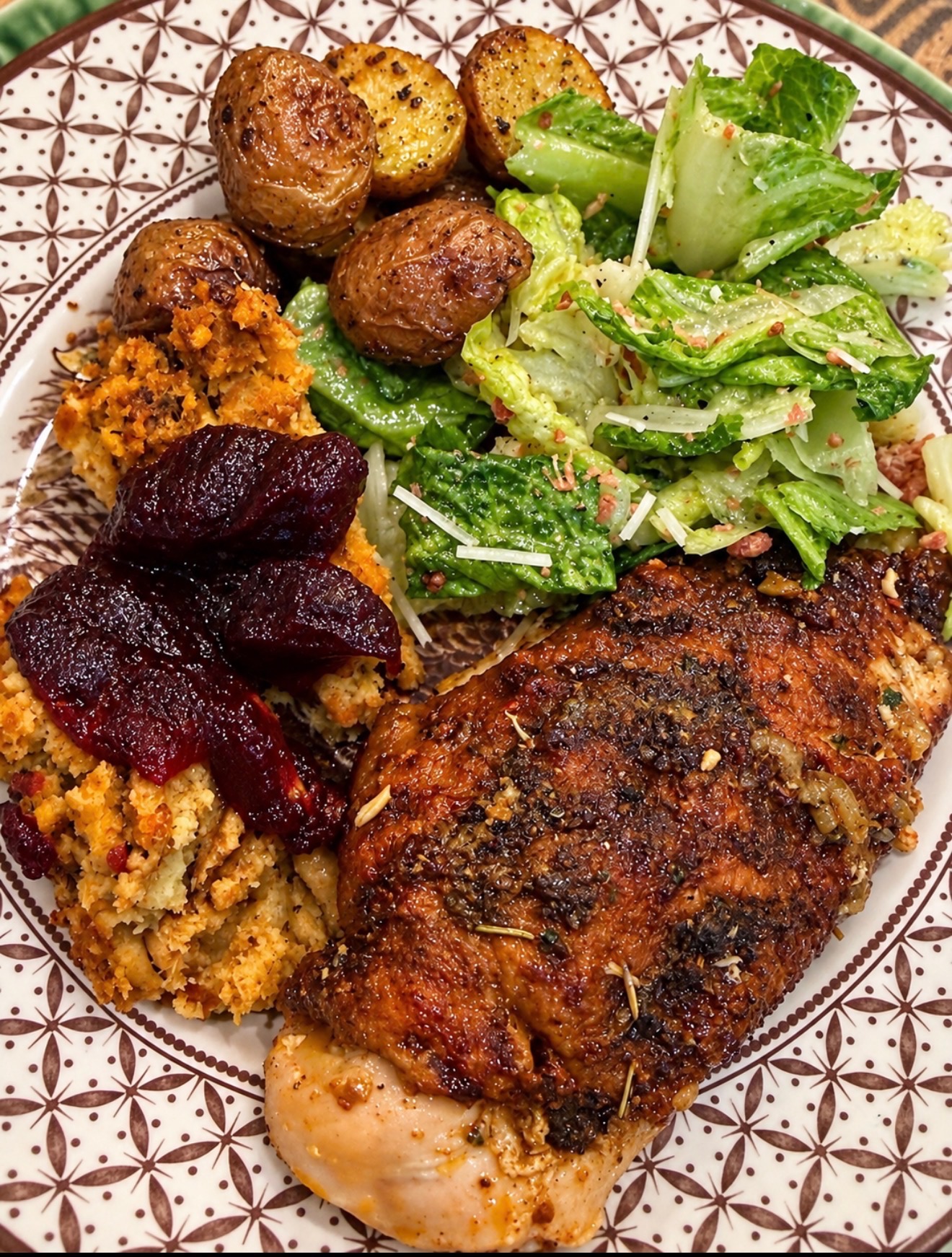
This is obviously incredible alongside Thanksgiving turkey, but don’t stop there.
Serve it with roasted chicken, pernil assado, roast beef or your favourite holiday main.
And honestly? You don’t need to be Portuguese to make this.
If you’re looking for an incredible stuffing recipe for Thanksgiving or Christmas, THIS is the one.
It’s comforting, ridiculously flavourful and easy enough that it may become one of those recipes your own family starts requesting every year.
That’s exactly how family recipes are born. ❤️
From My Cozinha to Yours ❤️
There’s something extra special about being able to share a recipe that came directly from my mother-in-law’s cozinha.
These are the recipes I want written down, made year after year and eventually passed down to our kids.
If you make my Portuguese Stuffing, leave a ⭐⭐⭐⭐⭐ rating and let me know what you think in the comments!
Save it to Pinterest for Thanksgiving and Christmas, and follow me on Instagram @rainha_da_cozinha for more Portuguese recipes, family favourites and a little modern-day avó life. 🇵🇹❤️
And don’t forget to join Letters from the Cozinha so my newest recipes come straight to your inbox.

🇵🇹 Portuguese Stuffing
Equipment
- pressure cooker
- food processor
- • Large mixing bowl
- medium pot
- wooden spoon
- 2 qt baking dish
Ingredients
- 1 whole Portuguese chouriço
- 800 g bread either 400 g pão de milho + 400 g pão d’água, or 800 g pão de milho
- Cold water for soaking
- 3-4 large egg yolks whisked
- 1 onion very finely chopped
- 3-4 cloves garlic very finely chopped
- 1 tablespoon Portuguese pepper sauce pimenta moída
- 1 tablespoon sweet paprika
- ¼-½ teaspoon Portuguese safflower optional
- ¼ teaspoon white pepper
- ¼ teaspoon black pepper
- ½ teaspoon salt or to taste
- 1 teaspoon ground cinnamon
- 1 cup chicken broth
- 1 tablespoon butter
Instructions
- Cook the chouriço.
- Place the whole chouriço in your pressure cooker with water. Pressure cook on HIGH for 1 hour. Carefully remove the chouriço and allow it to cool enough to handle. Cut it into pieces, transfer it to a food processor and pulse until finely ground. Set aside. No Pressure Cooker? No ProblemIf you don’t have a pressure cooker, you can prepare the chouriço on the stovetop instead. Place the whole chouriço link in a pot and cover it with water. Bring to a gentle boil, then reduce to a simmer and cook for about 25–30 minutes, or until the chouriço is cooked through and tender.Remove it from the water and let it cool slightly. Cut it into a few pieces, then add it to a food processor and pulse until finely ground. Set aside and continue with the recipe.
- Soak the bread.
- Break your 800 g of bread into pieces and place it in a large bowl. Cover with cold water and allow it to soak for approximately 5–10 minutes, or until even the harder crusts have softened. Using your hands, begin squeezing out the water. Start with the softer pieces and then work through the harder crusts. Squeeze the bread very well and break it apart with your hands as you go. You want soft, crumbled bread, not bread dripping with water.
- Add the egg yolks.
- Whisk 4 egg yolks. Pour them over the squeezed bread and use your hands to mix everything together very well. Set aside.
- Make the seasoning mixture.
- In a pot, combine the onion, garlic, pimenta moída, cooked chouriço, paprika, Portuguese safflower if using, white pepper, black pepper, salt, cinnamon, chicken broth and butter. Bring everything to a boil and cook for approximately 5 minutes. You want this mixture very hot when it goes over the bread.
- Mix everything together.
- Carefully add the bread to the hot seasoning mixture. Start mixing with a wooden spoon, mix until evenly combined.
- Bake.
- Transfer the stuffing to a 2-quart baking dish and spread evenly. Bake uncovered at 350°F (175°C) for approximately 30 minutes, or until the top develops a beautiful golden colour. Bake slightly longer if you prefer a drier stuffing.
Leave a Reply