
If you’ve ever visited the beautiful island of Terceira in the Azores, chances are you’ve experienced the unforgettable aroma of Alcatra slowly cooking away in a traditional clay pot. This isn’t just another beef stew. It’s one of the island’s most cherished dishes, often served during family gatherings, Sunday lunches, and the famous Festas do Espírito Santo.
What makes Alcatra so special isn’t a long list of ingredients. It’s the time, patience, and love that go into preparing it. Layers of beef, onions, garlic, smoky bacon, spices, and Portuguese wine slowly transform into one of the most tender, flavourful meals you’ll ever eat.
Like most Portuguese recipes, every family has their own version. Some add cinnamon, others don’t. Some finish the dish with butter for extra richness, while others keep it simple. This recipe is my version, inspired by tradition while staying true to the flavours of Terceira.
Jump to:
- What is Alcatra? 🏺
- 💡 Where can you find an Alcatra pot?
- Why You’ll Love This Recipe ❤️
- Ingredients 🥩🧅🍷
- Optional Ingredients
- How to Make Traditional Terceira Alcatra 👩🍳
- Tips for the Best Alcatra 💡
- What to Serve with Alcatra 🍽️
- Storage
- Frequently Asked Questions
- From My Kitchen to Yours ❤️
- Traditional Alcatra from Terceira 🇵🇹🍷
What is Alcatra? 🏺
Alcatra is a traditional slow cooked beef dish originating from Terceira, one of the nine Azorean islands of Portugal.
Traditionally, it’s prepared in an unglazed clay pot called an Alguidar de Alcatra. The porous clay allows the heat to circulate gently, creating incredibly tender meat and a rich, concentrated sauce.
Don’t worry if you don’t own one. A Dutch oven works beautifully too.
💡 Where can you find an Alcatra pot?
Many Portuguese butcher shops, Portuguese grocery stores, and specialty Portuguese kitchenware shops across Canada and the United States carry authentic clay Alcatra pots imported from Portugal. You can find a few different options here .
Why You’ll Love This Recipe ❤️
✔️ Authentic Terceira flavours
✔️ Only one bottle of Portuguese wine
✔️ Fall apart tender beef
✔️ Perfect for feeding a crowd
✔️ Even better the next day
✔️ Freezer friendly
Ingredients 🥩🧅🍷
One of the best things about Alcatra is that you don’t need exact amounts of every ingredient. The size of your Dutch oven or clay pot will determine how much beef and onions you’ll need. Simply fill your pot with layers, making sure every piece of beef is surrounded by onions and seasoning.
The ingredients that matter most are the quality of the beef, the Portuguese wine, and allowing enough time for everything to slowly cook together.
Beef 🥩
Use a well marbled cut such as chuck roast, blade roast, or cross rib. These tougher cuts become incredibly tender after hours in the oven.
Onions 🧅
You’ll need enough onions to create generous layers throughout the pot. As they cook, they melt into the broth, creating the rich sauce Alcatra is famous for.
Garlic 🧄
Fresh garlic is essential. It slowly sweetens as it cooks and flavours every layer.
Smoked Bacon 🥓
Traditional recipes use bacon or salted pork for richness and depth.
Portuguese Red Wine 🍷
This is one ingredient I wouldn’t substitute if you can help it.
Use one 750 mL bottle of Portuguese dry red wine.
Great options include:
Douro Red
Dão Red
Alentejo Red
Bairrada Red
A full-bodied Portuguese wine gives the sauce its signature richness while honouring the authentic flavours of the recipe. If you can get your hands on some homemade Portuguese wine, even better!
Bay Leaves 🌿
Adds subtle earthy flavour throughout the cooking process.
Whole Cloves
Just a few whole cloves give Alcatra its unmistakable aroma.
Whole Allspice (Pimenta da Jamaica)
One of the signature spices found in traditional Terceira Alcatra. You can also use ground all spice if you cannot find the whole spice.
Whole Black Peppercorns
Adds gentle warmth without making the dish spicy.
Lard 🧈
Traditionally, the clay pot is greased with lard before layering the ingredients. This adds richness and helps prevent sticking.
Optional Ingredients
Cabbage 🥬
I like placing a few cabbage leaves over the top before covering the pot.
This is completely optional but it’s a technique used in many Portuguese homes. The cabbage helps trap steam inside the pot, keeping the meat moist throughout the long cooking process. It also protects the top layer from drying out. The cabbage itself becomes incredibly soft and can be served alongside the beef if you enjoy it.
Butter 🧈
Some families add in a tablespoon or two of butter on top of the meat before cooking.
This is optional, but it gives the sauce an even silkier finish and a richer flavour.
How to Make Traditional Terceira Alcatra 👩🍳
One of the things I love most about Alcatra is that it isn’t a recipe you need to overthink. Once everything is layered into the pot, the oven does all the work. Low, slow cooking is what transforms simple ingredients into one of the most comforting meals in Portuguese cuisine.
Step 1: Prepare the Pot 🏺
Whether you’re using a traditional Alguidar de Alcatra or a Dutch oven, begin by generously greasing the bottom and sides with lard (banha).
This small step adds flavour while helping prevent sticking during the long cooking process.
Step 2: Build the First Layer 🧅🧄
Cover the bottom of the pot with a generous layer of:
sliced onions (cebolas)
sliced garlic (alho)
diced smoked bacon (toucinho fumado)
bay leaves (folhas de louro)
whole cloves (cravinhos-da-Índia)
whole allspice (pimenta da Jamaica)
whole black peppercorns (grãos de pimenta preta)
These aromatics slowly melt into the wine as they cook, creating the rich broth Alcatra is famous for.
Step 3: Add the Beef 🥩
Arrange a layer of large chunks of beef (carne de vaca) and veal (osso buco) over the onions.
Choose a well-marbled cut like chuck roast (acém) or blade roast (pá). These tougher cuts become incredibly tender after several hours in the oven.
Season lightly with coarse sea salt (sal grosso).
Step 4: Repeat the Layers
Repeat the entire process.
Another layer of:
onions
garlic
smoked bacon
bay leaves
cloves
allspice
peppercorns
Followed by the remaining beef and salt.
Think of it as building layers of flavour instead of simply mixing everything together.
Step 5: Pour in the Wine 🍷
Pour one 750 mL bottle of Portuguese dry red wine (vinho tinto português) evenly over the meat.
One bottle is the perfect amount for most standard Alcatra pots or Dutch ovens. The wine should come roughly halfway to three-quarters of the way up the meat. It doesn’t need to completely cover everything.
Which Portuguese wine should I use?
I recommend choosing a dry Portuguese red from one of these regions:
🍷 Douro
🍷 Dão
🍷 Alentejo
🍷 Bairrada
The wine is one of the stars of the dish, so using a Portuguese wine keeps the flavours authentic.
Step 6: Add the Butter and Cabbage (Optional)
This step is completely optional, but it’s one I like to include.
Place a few tablespoons of butter and cabbage leaves (folhas de couve) over the top before covering the pot.
This is completely optional but the butter gives the broth a silky, glossy finish and an extra layer of richness.
As the Alcatra cooks, the cabbage helps trap steam inside, locking in moisture and protecting the top layer of meat from drying out. It eventually becomes soft enough to enjoy alongside the beef.
Step 7: Slow Cook
Cover the pot tightly with its lid or aluminium foil.
Bake at 300°F (150°C) for approximately 6 to 7 hours, or until the beef easily falls apart with a fork.
Try not to uncover the pot while it’s cooking. Keeping the steam inside is part of what makes the meat so incredibly tender.
Your home will smell absolutely amazing long before dinner is ready.
Step 8: Finish with a Broil
Once the Alcatra is ready you can uncover the pot and remove cabbage and finish it off with a broil for some crispy pieces.
Tips for the Best Alcatra 💡
🇵🇹 Use Portuguese wine whenever possible.
🥩 Don’t trim too much fat from the beef. Fat equals flavour.
🧅 Don’t be afraid of the amount of onions. They practically disappear into the sauce.
🔥 Low and slow is the secret. Don’t rush it by increasing the oven temperature.
🍷 Alcatra tastes even better the next day.
What to Serve with Alcatra 🍽️
Traditionally, Alcatra is served with simple sides that soak up every last drop of that incredible broth.
My favourites are:
🍚 Portuguese White Rice (Arroz Branco)
🥔 Boiled Potatoes (Batatas Cozidas)
🍞 Fresh Portuguese Bread (Papo Secos)
🍞 Sweet Bread (Massa Sovada) for special occasions and Espírito Santo celebrations.
And don’t forget plenty of the rich sauce spooned over everything.
Storage
Store leftovers in an airtight container in the refrigerator for up to 4 days.
The flavours continue to develop overnight, making Alcatra one of those dishes that’s even better the next day.
Freezing
Alcatra freezes beautifully for up to 3 months.
Allow it to cool completely before transferring it, along with plenty of the broth, to freezer-safe containers.
Reheating
Reheat gently on the stovetop over medium-low heat or in a covered dish in the oven at 325°F (160°C) until warmed through.
Avoid boiling, as it can dry out the beef.
Frequently Asked Questions
Can I make Alcatra without a clay pot?
Absolutely! A Dutch oven works wonderfully and still produces incredibly tender beef.
Do I have to use cinnamon?
No. While some families include cinnamon (canela), many don’t. My version doesn’t use it, but feel free to add one cinnamon stick if you’d like to try that variation.
Can I use a different wine?
For the most authentic flavour, I recommend using a Portuguese dry red wine. It truly makes a difference.
Why do some people add cabbage?
The cabbage helps trap steam, keeping the meat moist during the long cooking process. It’s completely optional but is a traditional technique in some homes.
Can I make Alcatra ahead of time?
Yes! In fact, many people believe it tastes even better the following day once all the flavours have had time to develop.
From My Kitchen to Yours ❤️
Alcatra is so much more than a beef dish. It’s a recipe that represents family, tradition, and the beautiful island of Terceira. Every household has its own way of making it, and that’s what makes Portuguese cooking so special. Whether you’re making this recipe for the first time or recreating memories from home, I hope it brings a little piece of Portugal to your table.
If you make this recipe, I’d love to see it! Tag @rainha_da_cozinha on Instagram, leave a review below, and share it with someone who loves Portuguese food as much as we do.
Bom apetite! 🇵🇹❤️
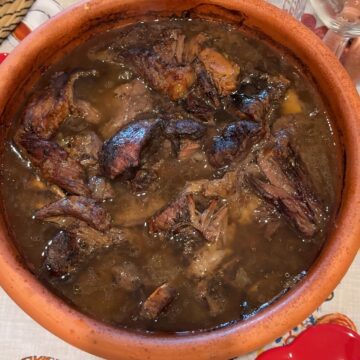
Traditional Alcatra from Terceira 🇵🇹🍷
Equipment
- 1 Dutch Oven use this option if you do not have the traditional pot
- 1 Alcatra Clay Pot
Ingredients
Meat
- 5-7 lbs beef chuck roast, blade roast and 1 thick veal piece (osso buco) 5-7 lbs total
Aromatics
- 4-6 large onions, sliced
- 8-10 garlic cloves, sliced or minced
- 200-250 grams smoked bacon (toucinho fumado), diced
Seasonings
- 4 Bay Leaves
- 8-10 whole cloves
- 1-2 tablespoon whole allspice (pimenta da Jamaica you can also use grounded allspice
- 2-4 teaspoon coarse sea salt
Liquids
- 1 750ml Portuguese dry red wine (some areas in Terceira prefer dry white wine instead)
For the Pot
- 2 tablespoon lard (banha)
Optional
- 1-2 tablespoon butter added on top of the meat before covering
- 1-2 cabbage leaves to cover the top
- 1-2 cinnamon sticks
Instructions
- 1. Prepare the PotPreheat your oven to 300°F (150°C).Grease the inside of a traditional Alcatra clay pot (alguidar) or Dutch oven with the lard (banha).
- . Build the First LayerCover the bottom of the pot with half of the: ● sliced onions ● garlic ● smoked bacon ● bay leaves ● cloves ● allspice ● black peppercorns
- 3. Add the BeefArrange half of the beef over the onion mixture.Season lightly with coarse salt.
- 4. RepeatRepeat the layers: ● Remaining onions ● Garlic ● Bacon ● Bay leaves ● Cloves ● Allspice ● PeppercornsFinish with the remaining beef and a light sprinkle of salt.
- 5. Pour in the WineSlowly pour one bottle (750 mL) of Portuguese dry red wine over the meat.The wine should reach roughly halfway to three-quarters of the way up the meat. It does not need to completely cover everything.
- 6. Add the Butter and Cabbage (Optional)Add 1-2 tablespoon of butter and/or Lay several cabbage leaves over the top of the meat.The butter adds a silky, tasty texture and the cabbage is a traditional technique that helps trap steam inside the pot, keeping the meat moist throughout the long cooking process while protecting the top layer from drying out.
- 7. Slow CookCover tightly with the lid or aluminum foil.Bake for 6 to 7 hours, or until the beef is incredibly tender and easily falls apart with a fork.Resist opening the lid while it cooks to keep all the moisture and flavour inside.
- 8. Finish (Optional)Uncover the pot and finish off with a broil for crispy pieces.Allow the Alcatra to rest for about 15 minutes before serving.


Leave a Reply